Allergies and dust: what cleaning and disinfecting your air conditioner really changes

The ClimatisateurPro team
2 Nov 2026 - 05 min read
Sneezing in the morning, itchy eyes, a thin grey film on the furniture: when these signs return as soon as the air conditioner is switched on, it is natural to wonder whether the unit is to blame. The answer is nuanced. An air conditioner produces neither pollen nor dust mites, but a dirty unit can spread what has built up inside it, whereas a clean, well-adjusted one helps keep the air comfortable.
Here is what an air conditioner actually traps, what a clean with disinfection achieves, and what it would be wrong to expect from it.
What an air conditioner filters, and what it lets through
A wall-mounted split air conditioner draws in room air, passes it over its coil (the heat exchanger that cools or warms the air), then blows it back out. It recirculates indoor air: it does not bring in fresh air. ADEME, the French environment and energy agency, makes the point in its indoor air quality advice: air conditioning replaces neither airing the room nor the home's ventilation.
Upstream of the coil sit the filters. On most household units these are fine plastic meshes designed to protect the heat exchanger. They stop hair, pet fur, fluff and visible dust. Some models add a secondary filter (activated carbon, electrostatic or ionising, depending on the manufacturer). None of these are HEPA filters: they are not built to capture most fine particles or the smallest allergens. Your unit's manual states exactly what it contains.
The direct consequence: an air conditioner is not an anti-allergy air treatment. A dirty unit, on the other hand, can make symptoms worse.
How a dirty unit keeps the problem going
Three mechanisms add up.
- Clogged filters let more dust through to the coil and the fan (the bladed cylinder that pushes air into the room). Deposits settle there, then break off in places when the unit starts.
- Moisture: in cooling mode, water in the air condenses on the coil and runs into a tray before draining away. If the tray drains poorly, or the unit stops while still wet, mould can take hold. Its spores are among the recognised indoor air allergens.
- Air movement: the airflow lifts dust that has settled on curtains, rugs or the tops of cupboards. The stronger the fan, the more it stirs up.
One clue is easy to spot: black specks on the louvres or on the fan blades, visible with a torch through the air outlet. These are deposits, often mixed with mould, that washing the filters alone never reaches.
What a clean with disinfection includes
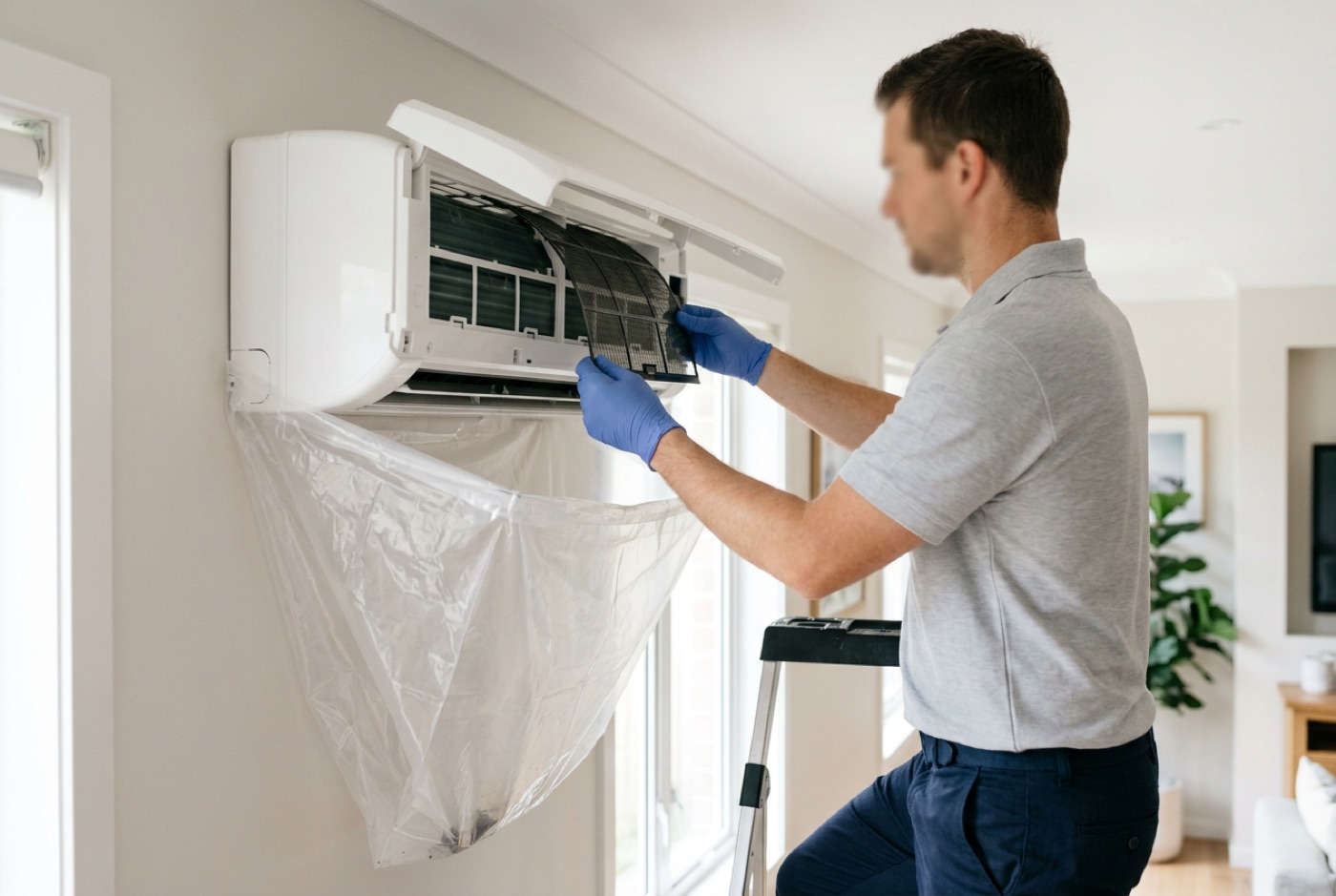
During a service visit, the air-conditioning technician does not stop at the filters. At ClimatisateurPro, the work covers the whole path of the air and the water:
- cleaning the filters;
- cleaning and disinfecting the indoor coil and the fan, with a product suited to air conditioners;
- checking and cleaning the condensate tray and its drain, so that water no longer stands;
- cleaning the outdoor unit;
- operating checks and setting advice tailored to how you use the unit.
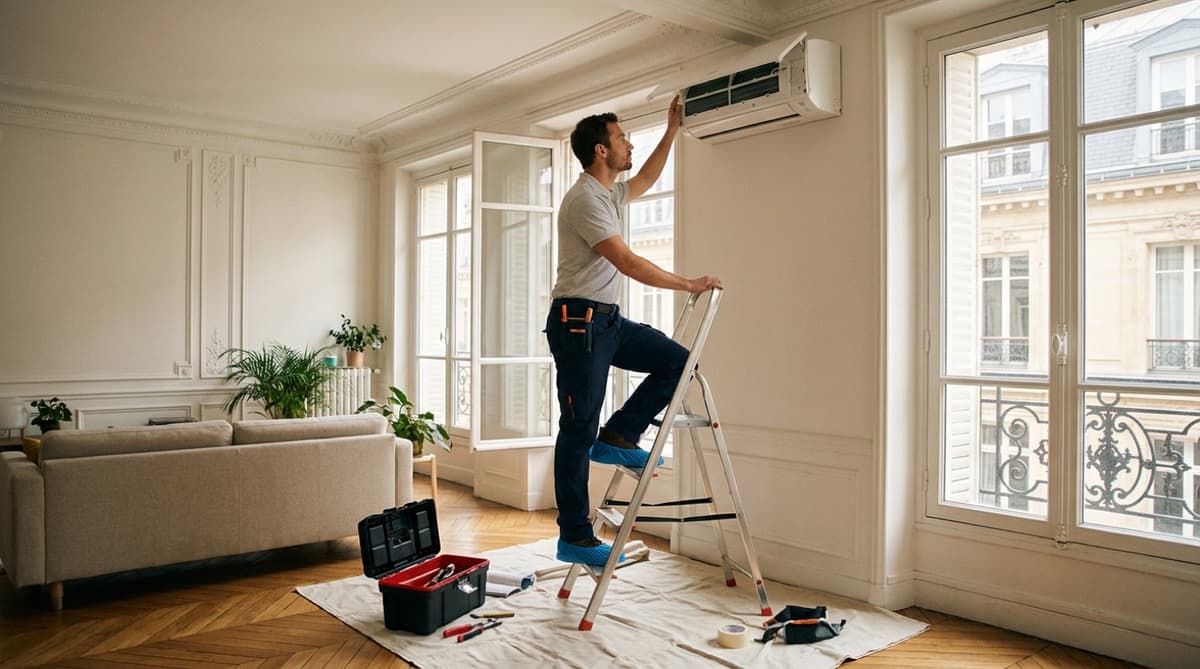
Before starting, the unit is switched off at the mains and a collection sheet is fitted under the indoor unit, so that rinse water touches neither the wall nor the floor. These precautions are described in our careful service commitment.
What you can expect: a unit that no longer blows its deposits into the room, condensate that drains normally, and airflow restored. What you should not expect: an end to a pollen or dust mite allergy, which depends mainly on your everyday exposure and on medical follow-up.
Humidity and dust mites: settings matter as much as cleanliness
Dust mites thrive in warm, humid air. Keeping relative humidity moderate, roughly between 40 and 60%, is one of the most widely given tips for limiting both mites and mould. An indoor thermometer and hygrometer placed in the bedroom is enough to know where you stand.
In summer, cooling mode dries the air while cooling it; dry mode, often shown as a droplet on the remote control, removes moisture with less cooling. Conversely, air that is too dry irritates the nose and throat: there is no point running the unit flat out all night.
A few settings help sensitive people:
- point the louvres towards the ceiling rather than at the bed or sofa;
- choose a moderate or automatic fan speed rather than the highest one;
- leave the unit on fan only for a few minutes after cooling to dry the coil, if your model has no automatic drying function.
What you can do between visits
- Wash the filters every two to four weeks during the season, in lukewarm water, and let them dry completely before refitting them. Do it outdoors or with the window open, so as not to spread dust around the room.
- Air the room every day: health authorities recommend opening the windows for at least 10 minutes a day, even when the air conditioning is on. During the pollen season, the bulletin from the French aerobiological monitoring network (RNSA) helps you pick the best time depending on the species.
- Dust with a damp cloth near the airflow rather than with a feather duster.
- Keep an eye on drainage: a unit dripping indoors, or a drain that stops flowing in cooling mode, points to a tray or pipe that needs cleaning.
For an allergy sufferer, an air purifier with a HEPA filter in the bedroom deals with fine particles, which the air conditioner does not. The two appliances do different jobs and complement each other.
How often to have your air conditioner cleaned
For a home, one service visit a year is the baseline, ideally before the hot season. It is all the more worthwhile if someone in the household has allergies or asthma, if you have pets, or if the unit also heats in winter. In a busy shop, an open kitchen or a hair salon, two visits a year are often more suitable.
After each visit, you receive the unit's digital maintenance log: date, work carried out, observations and photos. It lets you follow the unit's condition from one year to the next and show your landlord or managing agent what has been done. Our active vigilance then takes over: we get back in touch before the next season.
Having your air conditioner cleaned in Île-de-France
Our air conditioning servicing and cleaning includes disinfecting the coil and the fan. The price is shown before you book: €130 including VAT for one indoor and one outdoor unit, €40 per additional indoor unit, with no travel charge in Paris and across Île-de-France. To learn about our approach to unit hygiene, read our healthy air commitment, then choose your slot on the booking page.
Entrust your air conditioner to an attentive technician